 |
|
The John Paul Stevens Vacancy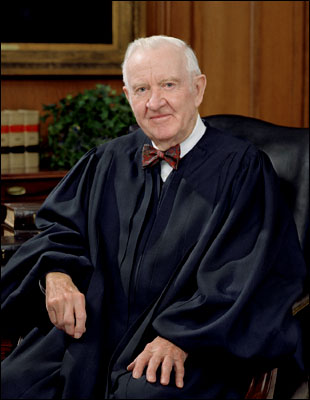
Justice William O. Douglas wanted so desperately to remain on the Supreme Court through the presidency of Gerald Ford. After all, Ford, when minority leader of the House before being picked by President Nixon to assume the vice presidency vacated by Spiro Agnew, led a much publicized, though doomed effort to impeach the most liberal justice remaining from the Warren Court of the 50s and 60s. But the inability of Douglas to recover from a December 1974 stroke led to his retirement from the Court in November of 1975. Gerald Ford, in the meantime, had troubles of his own trying to keep the Republican Party from disappearing off the political map in the wake of Richard Nixon's Watergate scandal and subsequent resignation. The Republicans were down 24 seats in the Senate and Ford's approval rating sat at 41%. Having no desire to waste political capital on a Supreme Court nomination and seeking to appear as bipartisan as possible, Ford instructed his Attorney-General, Edward Levi, to find the best possible candidate. The result was perhaps the least ideologically-motivated appointment from among those of the past 80 years—Judge John Paul Stevens of the Seventh Circuit, confirmed by a vote of 98-0, and sworn in on December 19, 1975. When he retires this summer, Stevens will depart as the second oldest person to serve as a justice and perhaps with the second longest term of service. His thirty-four and a half years will come up short of the thirty-six and a half years recorded by his predecessor, William O. Douglas. Stevens will be 90 when he retires, older than all other justices except the majestic Oliver Wendell Holmes, who retired at 91. Stevens is generally viewed as one of the Court's liberals, although only about half the cases decided in any term can be identified along a conservative/liberal dimension. In practice that has meant applying the Bill of Rights to limit government's control over individuals, championing equal protection, and typically displaying the liberal preference of equality over liberty and liberty over community. Over the past decade, Stevens, perhaps more than any other of the liberals, has made clear that judicial activism is not the intellectual property of the left but is now more evident among the conservative justices, intent on pursuing their conservative agenda for the Court. Bush v. Gore (2000), Rasul v. Bush (2004), D.C. v. Heller (2008), Citizens United v. Federal Election Commission (2010) are among the cases that pit Stevens against a conservative bloc that he reveals to be at once political, deferential to executive authority, dismissive of precedent, willing to ignore the will of the legislative branch, and ready to construe language and construct original intent in a manner consistent with its ideological biases. Stevens has displayed a prodigious work ethic, from reviewing petitions and writing his own first drafts to working with colleagues to achieve a consensus that may well elude a Court without his presence. By one count, he has written over 600 dissents during his 34 years, which means his impact on the Court remains to be seen. This vacancy has come about almost surely to provide President Obama an opportunity to make an appointment prior to the 2010 election while the strong Democratic majority in the Senate remains intact. Check the links below to learn more about the setting in which this vacancy occurs and the interim period between the vacancy and the confirmation hearing in the Senate, which includes an identification and assessment of various potential nominees.
Created on April 9, 2010 by GW |
|