 |
|||||||||||||||||||||||
|
The Souter Vacancy Setting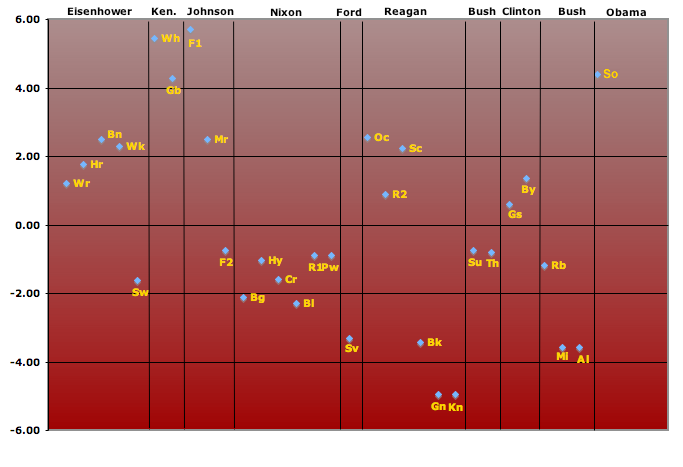
The setting in which the Souter vacancy is likely to be filled (keep in mind there is no vacancy until Souter actually leaves the Court) is one in which President Obama could nominate virtually any(qualified)one— with one significant caveat. As President Bush learned in putting forward Harriet Miers to replace Justice O'Connor, you must be certain to have the support of your own party in the Senate. As you see in the setting chart, the Miers nomination (Mi) came at a time that was ripe for controversy. (See the Nomination Setting link for a full description of this setting chart.) Despite a 55-45 Republican majority in the Senate, with its accompanying 67% support rate of voting with the president, Bush's approval rating with the public was down to 40% and moving south. In addition, the nomination was a significant one for the liberals/Democrats. The vacancy was one of the two women on the Court and O'Connor was the median justice, the swing vote in the relatively few 5-4 decisions that liberals were able to manage in an otherwise conservative Court. In appointing Miers, Bush had apparently mollified the opposition by appointing perhaps the best they could hope for, namely, a woman whose conservative credentials were yet to be fully tested in a judicial setting. The more conservative of the Republicans, however, were outraged, fearing that Miers would not be a strong conservative voice on the Court, no better at best than O'Connor. Replacing Miers with the solidly credentialed Alito in this potentially controversial setting resulted in a relatively narrow 58-42 confirmation vote. Obama appears at the moment to have a very positive setting for his first nomination to the Supreme Court (SV in the chart). With an anticipated 20 seat majority over the Republicans, over 90% support in the Senate on those items on which he has taken a stand, and a job approval rating in excess of 60%, the confirmation road for an Obama nominee looks pretty clear. This is especially so given that Souter is one of the four more liberal members of the Court. The Souter seat will not be seen by most conservatives/Republicans as a critical one, although conservative ideologues will be sensitive to having the somewhat placid Souter replaced by anyone seen as a liberal ideologue. How they perceive Sotomayor remains to be seen. So, the very positive setting for Obama means that he can get any nominee confirmed who pleases just over 5/6ths of the Democrats. He needs no Republican support. Admittedly, the setting variable is somewhat inflated by the Senate support variable. Obama has taken positions on very few issues voted on in the Senate (only 11 as of the first of May), either getting his way or simply picking winners over 90% of the time. The issue for Obama is not picking a nominee who can be confirmed, but how much bipartisan support he wants for the nominee. Would the setting, for example, permit the appointment of a lesbian liberal with a jurisprudence that eschews the literal original intent doctrine of the conservative right in favor of a "constitutional fidelity" approach? Yes, but not without a battle from the political right. The fact that he has chosen a sitting judge of some 17 years experience, an Hispanic woman, one regarded as perhaps less a liberal ideologue than many on the left might have preferred, should make this a relatively noncontroversial nomination, to the extent that oppositional advocacy groups are ever willing to let one go by in this media age.
Created on May 26, 2009 by GW |
||||||||||||||||||||||